
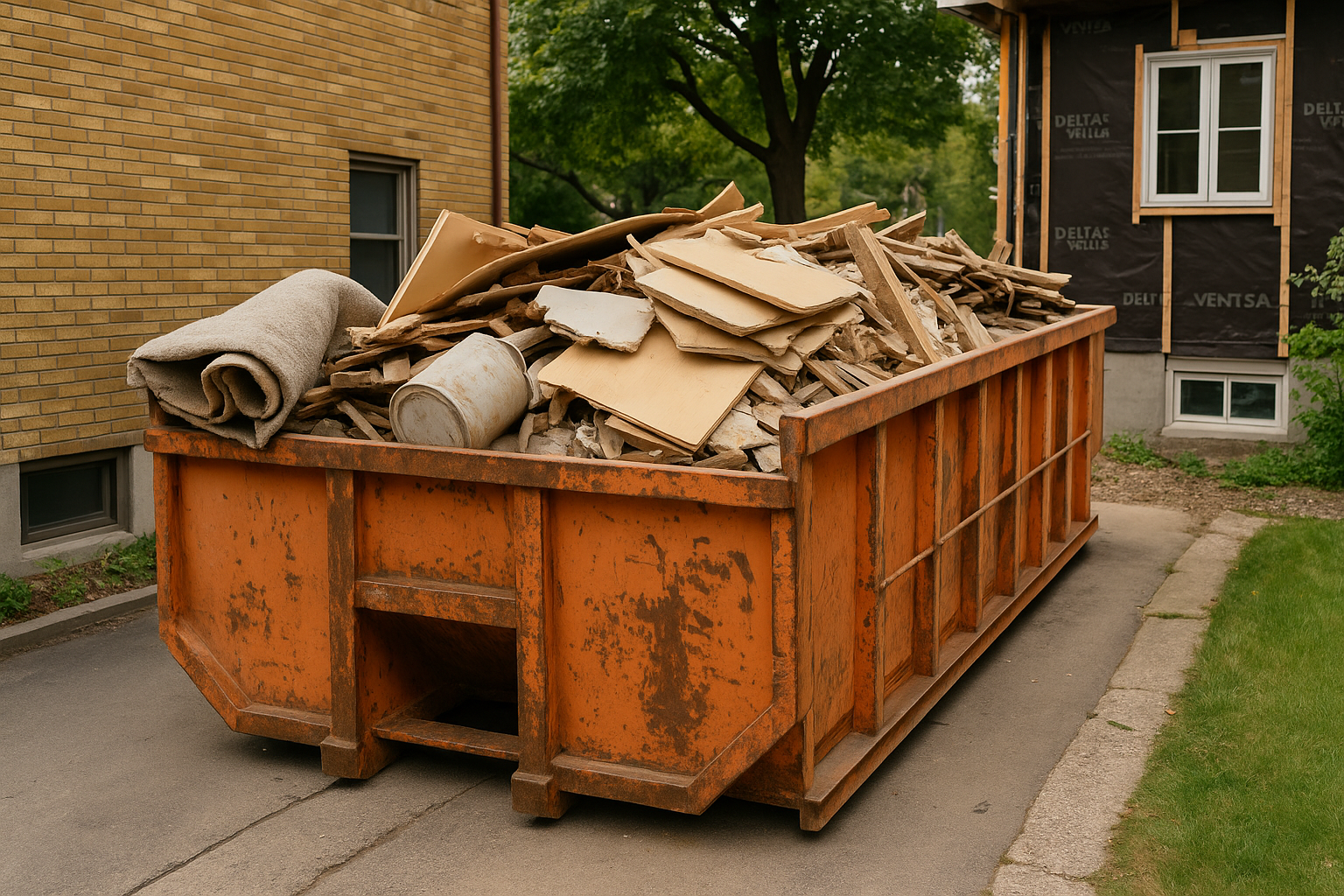
A disaster at home – be it fire, water damage or mold – turns daily life upside down. Between the urgency of securing the premises, dealing with the insurance company and planning repairs, another crucial question arises: what to do with all the waste generated by cleaning and renovations?
Damaged materials, irretrievable furniture, unusable household appliances, construction waste… their accumulation can compromise safety and progress, and complicate logistics. To simplify this process, renting a container is a practical, fast and environmentally-friendly solution.
Types of claims and associated waste
🔥 Fire
A fire – even a partial one – causes considerable damage. Materials often requiring evacuation include :
- Burnt wood and gypsum
- Charred furniture
- Damaged insulating materials
- Appliances melted down or out of order
- Shattered tiles and ceramics
Even if some objects appear intact, soot and smoke odors make them unusable.
💧 Water damage or flooding
Very common in Quebec, water damage can occur due to :
- Leaks (roof, plumbing)
- Sewer backup
- Spring flooding
Typical wastes include :
- Warped floors
- Damp gypsum walls or fences
- Mould on textiles, carpets, fabric furniture
- Swollen wood laths
🦠 Mould and insalubrity
When a dwelling is uninhabited or poorly ventilated, mold and vermin can develop. In this case, you need to dispose of :
- Full wall panels
- Old mattresses and sofas
- Contaminated textiles, curtains, clothing
- Moldy baseboards and woodwork
📘 Read also: Why renting a container is the best option for home renovations
Why rent a container?
✅ Simplified logistics
Having a container in your home means you don’t have to store waste in the yard, garage or in rooms that are still clean. This reduces health risks, such as the spread of bacteria and spores.
✅ Time-saving
A container saves you trips to the ecocenter. You can dispose of your materials day after day while the work is in progress.
✅ Compliance with safety standards
A closed container confines hazardous materials, prevents access by children or curious onlookers, and limits the dispersion of waste into the surrounding area.
What container sizes should I choose?
| Allocated area | Recommended size |
|---|---|
| 1 room (small claim) | 10 cubic yards |
| 2 to 3 rooms | 14 cubic yards |
| Complete house / duplex | 20 cubic yards and more |
| Worksite with demolition | Worksite container |
📘 See also: How to choose the right container size
What you can (and can’t) throw away
✅ Accepted :
- Gypsum partitions, plaster
- Broken or contaminated furniture
- Wood, doors, cabinets
- Porous materials (insulation, carpets)
- Damaged appliances (without liquid)
- Unusable clothing
❌ Refused :
- Gas or propane tanks
- Paint or solvent residues
- Tires, batteries, oils
- Household chemicals
📘 Also read: Container rental for worksites: 8 common mistakes to avoid
Sorting and recycling: respecting the environment
Even in a disaster situation, some materials can be sorted and recycled:
| Sorted materials | Valuation |
|---|---|
| Uncontaminated dry wood | Recycled or composted |
| Metals (nails, electro) | Melts for reuse |
| Bricks and concrete | Crushed into aggregates |
| Cardboard and dry paper | Recycled |
Good sorting at source reduces sorting costs at the treatment center, and promotes the circular economy.
What is the ideal rental period?
Most homeowners rent a container for 3 to 7 days, while they sort out and coordinate the start of work. However, SMAG Express also offers :
- Express rental (24 to 48 hours)
- Extended rental (1 to 4 weeks)
- Rotation service for large volumes
Insurance: what you need to know
✅ Does insurance cover container rental?
Yes, in many cases. If the container is needed for decontamination or cleaning, insurers include it in the reimbursable expenses.
💡 Tip: keep your invoices and photos of the waste to justify the need.
✅ Do I have to notify my insurer before the rental?
This is not mandatory, but recommended. Mentioning this step can facilitate reimbursement.
✅ Is the container covered against theft or accidents?
SMAG Express containers are robust, but you can ask for temporary protection (extended home insurance or worksite clause).
Coordination with contractors
Renovation companies prefer to work in open areas. Container:
- Speeds up their work
- Facilitates scrap management during construction
- Keeps parts clean as you go
SMAG Express can coordinate delivery and collection before or after your contractor’s intervention.
Fictional testimonial: Claire, claimant in Laval
“After an electrical fire in our kitchen, we had to redo the first floor. The 20-cubic-yard container allowed us to dispose of everything stress-free. SMAG picked it up the same day the work was completed. Insurance covered the rental 100%. I recommend it!”
Practical tips
- Protect healthy objects before disposing of waste.
- Do not overload the container (no higher than the rims)
- Photograph the contents in case of a claim
- Provide parking space for deliveries
FAQ – Frequently asked questions
1. Can I share a container with my neighbor who has also suffered a disaster?
Yes, as long as you respect the authorized materials.
2. Can I keep the container for more than 7 days?
Yes, extensions are possible depending on availability.
3. Can the container be placed in an alley?
Yes, if there’s enough space. Municipal authorization may be required.
4. Is the container rain/snow resistant?
Yes, they’re waterproof and secure.
5. Is pickup automatic?
No, you schedule the pick-up at a time that suits you.
Conclusion
Renovation waste after a disaster doesn’t have to be inevitable. With a professional service like SMAG Express, you can dispose of it efficiently, quickly and responsibly. You’ll simplify your procedures, speed up the work, protect your health… and save precious time.
🎯 Renting a container means turning a difficult step into a controlled process.
📞 Contact the SMAG Express team today for a free quote, tailored to the severity of your claim.

